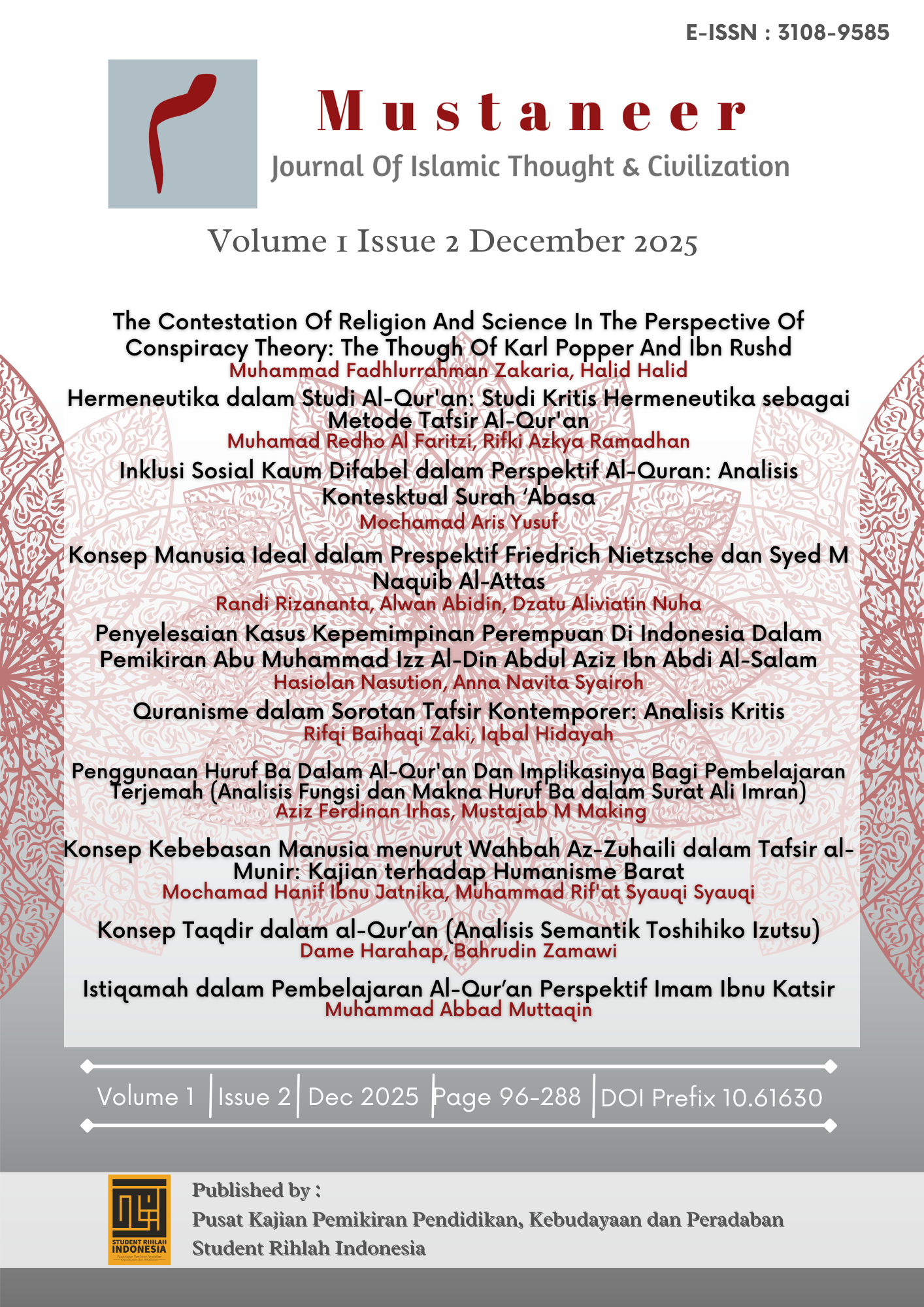
Penggunaan Huruf Ba Dalam Al-Qur'an Dan Implikasinya Bagi Pembelajaran Terjemah (Analisis Fungsi dan Makna Huruf Ba dalam Surat Ali Imran)
Bilah Samping Artikel
Isi Artikel Utama
Abstrak
Effective communication relies heavily on understanding the meaning of words. Unfortunately, understanding the Qur'an is often incomplete. The data understanding of the letter "ba" which is only interpreted as "with," even though it has a various meaning. This study aims to understand the function and deepen the meaning of the letter ba, specifically in examining Surah Ali Imran. This study applies a literature study approach with the Miles and Huberman data analysis model, namely collection, reduction, presentation, and extraction. The results of the analysis showed that the letter "ba" has 13 meanings, categorized as ma'ani letters that function to make “kasrah” of the followers. However, in Surah Ali Imran, 131 letters "ba" were found in 10 different meanings: ba lil-ilshaq (true and figurative), ba lil-isti'anah, ba lis-sababiyah, ba lil-'iwadh, ba lil-badali, ba lidz-dzarfiyah, ba lil-mushahabah, ba lit-tab'idiyah, ba lil-isti'la, and ba liz-zaidah. The implication of this research is in translation learning, which provide a comprehensive understanding of the function and meaning of the letter "ba" when dealing with religious texts. This research will help in achieving accuracy and harmony in the translation process.
##plugins.themes.bootstrap3.displayStats.downloads##
Rincian Artikel
Bagian

Artikel ini berlisensiCreative Commons Attribution-ShareAlike 4.0 International License.
You are free to:
- Share — copy and redistribute the material in any medium or format for any purpose, even commercially.
- Adapt — remix, transform, and build upon the material for any purpose, even commercially.
- The licensor cannot revoke these freedoms as long as you follow the license terms.
Under the following terms:
- Attribution — You must give appropriate credit , provide a link to the license, and indicate if changes were made . You may do so in any reasonable manner, but not in any way that suggests the licensor endorses you or your use.
- ShareAlike — If you remix, transform, or build upon the material, you must distribute your contributions under the same license as the original.
- No additional restrictions — You may not apply legal terms or technological measures that legally restrict others from doing anything the license permits.
Notices:
You do not have to comply with the license for elements of the material in the public domain or where your use is permitted by an applicable exception or limitation .
No warranties are given. The license may not give you all of the permissions necessary for your intended use. For example, other rights such as publicity, privacy, or moral rights may limit how you use the material.
Cara Mengutip
Referensi
Abdillah, L. A., Sufyati, H. S., Muniarty, P., Nanda, I., Retnandari, S. D., Wulandari, W., Prasetyo, A. H., Sinambela, S., Mansur, M., Aulia, T. Z., Hamzah, A., Firmansyah, H., Andari, S., Rismadi, B., Purba, S., Gazi, G., & Sina, I. (2021). Metodologi Penelitian & Analisis Data Comprehensive (S. S. Posangi, I. Kusumawati, & Z. Zaharah, Eds.). Penerbit Insania. http://insaniapublishing.com
Abdussamad, Z. (2021). Metode penelitian kualitatif. Syakir Media Press. https://repository.ung.ac.id/karyailmiah/show/8793/buku-metode-penelitian-kualitati.html
Abumahfouz, A. M., & Al-Shboul, Y. I. (2020). Qur’anic semantic markedness: A translation and linguistic perspective. Dirasat, Human and Social Sciences, 47(1), 302–313.
Afriati, I. (2021). Urgensi literatur Arab dalam proses pembelajaran pendidikan agama Islam dan budi pekerti di sekolah umum. Jurnal Mimbar Akademika, 6(1), 53–66. https://pengertiandefinisi.com/
Agustini, A. (2021). Urgensi pemahaman bahasa Arab dalam mempelajari agama Islam di Indonesia. IN RIGHT: Jurnal Agama Dan Hak Azazi Manusia, 10(2), 166–183. https://doi.org/10.14421/inright.v10i2.2922
Ahyar, H. (2018). Penguasaan mufrādat dan qawā’id upaya meningkatkan keterampilan menulis bahasa Arab siswa kelas X IIK MAN 1 Sleman Yogyakarta. Al Mahāra: Jurnal Pendidikan Bahasa Arab, 4(2), 257–272.
Aisyah, S. (2024). Implementasi metode qowa’id wa tarjamah dalam pembelajaran maharah qira’ah di Madrasah Diniyah Pondok Pesantren Rohmaniyah Lumajang. Al-Ahruf: Journal for Arabic and Linguistics Education, 2(1), 65–79.
Akyüz, Y. (2024). Politeness Theory in Arabic Language: Analysis of Dialogues in the Context of al-Istifhām Style in the Quran. Hitit Theology Journal, 23(2), 610–632. https://doi.org/10.14395/hid.1534187
Al-Alusi, Syihabuddin As-Sayyid Mahmud. (Tahun Terbit). Rūḥ al-Maʻānī fī Tafsīr al-Qurʼān al-ʻAẓīm wa al-Sabʻ al-Mathānī. Beirut: Dar Ihya' al-Turath al-'Arabi.
Al-Ghulayaini, M. (2010). Jami’ul Durus Al-Lughah Al-’Arabiyah. Muwassasah Al-Risalah Nasyirun. chrome-extension://efaidnbmnnnibpcajpcglclefindmkaj/https://dn790004.ca.archive.org/0/items/JamieDurus/JamieDurus.pdf
Ali, U. M. A. M. (2020). Quranic guidance extracted and induced from the events of Uhud battle in Surah of Ali Imran. Quranica: Jurnal Internasional Riset Al-Quran, 4, 127–154. https://www.academia.edu/44641790/QURANICA_International_Journal_of_Quranic_Research_Vol_12_Issue_1_Special_Issue_4_February_2020_Quranic_Guidance_Extracted_and_Induced_from_the_Events_of_Uhud_Battle_in_Surah_of_Ali_Imran_
Amadi, A. S. M., & Hikmah, K. (2025). Persepsi mahasiswa tentang pemanfaatan teknologi AI dalam pembelajaran bahasa Arab di perguruan tinggi Islam Indonesia. Journal of Education Research, 6(2), 292–301.
Annashir, A., Gajah, A. S., & Ayu, C. S. (2023). Penerapan metode ceramah dalam meningkatkan pemahaman qawaid pada pembelajaran bahasa Arab di MIS Al-Washliyah Sei Buluh. Abdu: Jurnal Pendidikan Madrasah Ibtidaiyah, 6(2), 119–132.
Annisa, M. N., Arista, D., La Udin, Y., & Wargadinata, W. (2023). Pemerolehan bahasa Arab sebagai bahasa kedua (Kajian psikolinguistik). `A Jamiy : Jurnal Bahasa Dan Sastra Arab, 12(2), 468–484. https://doi.org/10.31314/ajamiy.12.2.468-484.2023
Asdaliah, N., Mukhtar, M., Hamzah, H., Mahmud, B., & Mujahid, M. (2022). Huruf jar ba dan kandungan maknanya dalam Q.S. Al-Maidah. Loghat Arabi: Jurnal Bahasa Arab Dan Pendidikan Bahasa Arab, 3(1), 69–86.
Aziz, A., & Zakir, S. (2022). Tantangan pembelajaran pendidikan agama Islam di era 4.0. IRJE: JURNAL ILMU PENDIDIKAN, 2(3), 1070–1077. https://irje.org/index.php/irje
Bahaaldin, M. S., & Che Hat, N. (2024). النمل سورة سياق في الجر حروف ملعاني نحوية دراسة [A GRAMMATICAL STUDY OF THE MEANINGS OF PREPOSITIONS IN THE CONTEXT OF SURAT AL-NAML]. AFAQ LUGHAWIYYAH, 2(2), 197–209. https://journal.unisza.edu.my/afaq
Djuaeni, M. N., Mahmud, B., & Hamzah, H. (2021). Huruf “Ba” dalam bahasa Arab dan implikasinya terhadap penafsiran ayat Al-Qur’an. Diwan : Jurnal Bahasa Dan Sastra Arab, 7(1), 50. https://doi.org/10.24252/diwan.v7i1.20511
Dodego, S. H. A. (2022). Pentingnya penguasaan bahasa Arab dalam pembelajaran pendidikan agama Islam. PESHUM : Jurnal Pendidikan, Sosial Dan Humaniora, 1(2), 55–70.
Drajat, A. (2017). Ulumul Qur’an: Pengantar ilmu-ilmu Al-Qur’an (1st ed.). Kencana. chrome-extension://efaidnbmnnnibpcajpcglclefindmkaj/https://dn790004.ca.archive.org/0/items/pengantar-ulumul-quran/Pengantar%20Ulumul%20Quran.pdf
Dwi Maheningsih, D., & Rahmatsyah, R. (2023). Asbabun nuzul Islamic education perspective. Sinergi International Journal of Islamic Studies, 1(2), 76–84. https://journal.sinergi.or.id/
Fadhli, F., Rusdi, R., & Agustiar, A. (2024). Analisis kemampuan maharatul qira’ah siswa kelas X Madrasah Aliyah Negeri 1 Kepulauan Meranti. Jurnal Pendidikan Educandum, 4(2), 22–35. https://doi.org/10.55656/jpe.v4i2.210
Fauzi, L. K. N., & Nurjannah, N. (2024). Pendidikan karakter pada psikolinguistik dalam pembelajaran bahasa Arab untuk anak. Jurnal Bahasa Arab, 1(1), 21–32. https://creativecommons.org/licenses/by-sa/4.0/
Gani, S. (2022). Huruf ba (ب) jar dalam bahasa Arab dan maknanya dalam al-Quran Surah al-Baqarah. `A Jamiy : Jurnal Bahasa Dan Sastra Arab, 11(2), 486–493. https://doi.org/10.31314/ajamiy.11.2.486-493.2022
Hajar, H. I., & Qohar, H. A. (2024). Pendekatan inovatif untuk mengatasi tantangan pembelajaran nahwu dan sharaf bagi peserta didik. Ranah Research: Journal of Multidisciplinary Reserch and Development, 6(6). https://doi.org/10.38035/rrj.v6i6
Haq, M. Z. (2022). Rekonstruksi atas relasi pendidikan agama Islam dan pendidikan bahasa Arab melalui sudut pandang sosial. STAINU Purworejo: Jurnal Al Ghazali Jurnal Kajian Pendidikan Islam Dan Studi Islam, 5(1), 1–11. https://ejournal.stainupwr.ac.id/
Harlina, H. (2024). Urgensi dan kontribusi asbabun nuzul: Analisis pentingnya konteks dalam memahami makna ayat Al-Qur’an. JI: JOURNAL OF IDEAS, 1(1), 53–66. https://barkah-ilmi-fiddunya.my.id/ojs/index.php/ji/article/view/42
Hasan, N. H. M., Romli, T. R. M., & Basir, M. N. (2020). Analisis terjemahan kata nama khas Melayu-Arab dalam novel ‘al-ustaz.’ Muallim Journal of Social Science and Humanities, 4, 135–143. https://doi.org/10.33306/mjssh/88
Hasanah, M. (2022). Studi Nuzulul Qur’an dalam kajian Al-Qur’an. TAFAKKUR: Jurnal Ilmu Al-Qur’an Dan Tafsir, 3(1). https://www.uii.ac.id/memahami-al-quran-
Hawamdeh, M. A., & Kadhim, K. A. (2015). Parenthetical cohesive explicitness: A linguistic approach for a modified translation of the quranic text. International Journal of Applied Linguistics and English Literature, 4(5), 161–169. https://doi.org/10.7575/aiac.ijalel.v.4n.5p.161
Hindun, H., & Humaidi, H. (2024). Interferensi bahasa daerah dalam pembelajaran bahasa Arab: Analisis dampak pada struktur sintaksis dan pemahaman semantik. Qismul Arab: Journal of Arabic Education, 3(02), 99–112. https://doi.org/10.62730/qismularab.v3i02.94
Isma’i, H. (n.d.). Jadwal huruf. Al Haromain.
Ismail, U. S., Yusop, J. S., Atoh, N., Chulan, M., Radzi, A. H. M., Ismail, N., Pisal, N. A., & Zaki, M. F. M. (2022). Monitor model theory as a solution to overcome the problem of mastering Arabic grammar among students in Malaysia. Theory and Practice in Language Studies, 12(8), 1516–1524. https://doi.org/10.17507/tpls.1208.07
Juliani, A., Anggraini, P., & Rehayati, R. (2025). Integrasi teori linguistik Ferdinand de Saussure dalam metodologi pembelajaran bahasa Arab pada pendidikan agama Islam. Jurnal Penelitian Dan Pendidikan Agama Islam, 2(2), 358–364.
Jumadi, J., Karsani, K., Rama, B., & Saleh, S. (2024). Kendala penguasaan bahasa Arab pada mahasiswa pendidikan agama Islam UNIMUDA Sorong semester 3 angkatan 2023/2024. Agustus, 3(2), 386–396.
Kholifah, N., Al-Anwar, S., & Rembang, S. (2022). Ragam penerjemahan huruf jar min dalam “Qur’an Karim dan Terjemahan Artinya” terbitan UII: Studi pada Surah al-Baqarah. Al Itqan : Jurnal Studi Al-Qur’an, 8(1), 39–74. https://doi.org/10.47454/itqan.v8i1.771
Kurnia Yahya, Y., Mahmudah, U., & Muhyiddin, L. (2020). De-sakralisasi dalam pembelajaran bahasa Arab di Indonesia: Analisis bahasa sebagai identitas agama. Jurnal Lingua Applicata, 3(2), 57–70. https://jurnal.ugm.ac.id/jlaHal.57-70
Malik, I., Hairuddin, H., Miolo, M. I., & Samad, M. A. (2023). Silent way method sebagai alternatif pembelajaran maharatul istima’. Al-Kilmah: Jurnal Pendidikan Bahasa Arab Dan Humaniora, 2(2), 49–60. https://doi.org/10.58194/alkilmah.v2i2.1850
Mukhlis, M. (2023). Analysis of the study asbabun nuzul: “The urgency and contribution in understanding the Qur’an.” Al-Muhith: Jurnal Ilmu Al-Qur’an Dan Hadits, 2(2), 88–106. https://doi.org/10.35931/ak.v2i2.2945
Mulyati, M., Rahayuningsih, P. D., & Taufik, R. (2024). Analisis psikolinguistik: Dampak bahasa ibu terhadap respons emosional yang memengaruhi komunikasi verbal. JUPENSAL, 1(3), 492–498.
Ningtias, R. K. (2021). Analisis kesulitan belajar maharoh kalam pada mata kuliah bahasa Arab mahasiswa jurusan pendidikan agama Islam Institut Agama Islam Tarbiyatut Tholabah Lamongan. Darajat: Jurnal Pendidikan Agama Islam, 4(1), 91–100. https://doi.org/10.58518/darajat.v4i1.1751
Pimada, L. H., Amrulloh, M. A., Zahra, D. N., & Syahid, A. H. (2020). Error analysis in writing hamzah: What have to students do? Ijaz Arabi Journal of Arabic Learning, 4(1), 143–159. https://doi.org/10.18860/ijazarabi.v4i1.9870
Putri, F. S., Fitri, F. Z., Rahmadiningsih, I., & Hasbi, M. Z. N. (2022). Makiyah dan madaniyah. Al-MUBARAK: Jurnal Kajian Al-Quran & Tafsir, 7(1), 43–61. http://journal.iaimsinjai.ac.id/indeks.php/al-mubarak
Romadhoni, A. A., Syarifuddin, S., & Syaifullah, S. (2023). Implementasi metode qawaid dan terjemah dalam pembelajaran maharah qira’ah santri Pondok Pesantren Tarbiyatul Qur’an (TQ) Darussalam Talang Watuagung Prigen. Jurnal Mu’allim, 5(2), 355–368. https://doi.org/10.35891/muallim.v5i2.4135
Rostandi, U. D. (2021). Manajemen peningkatan mutu dosen pendidikan tinggi keagamaan Islam swasta di Jawa Barat (Studi kasus di STAIPI Bandung). Edukasi Islami: Jurnal Pendidikan Islam, 10(2), 479–506. https://doi.org/10.30868/ei.v10i01.1376
Saleh, Bahjat Abdul Wahid. (Tahun Terbit). Al-I’rāb al-Mufaṣṣal li Kitāb Allāh al-Murattal. Vol. 1. Beirut: Dār al-Fikr.
Sathisha, M. (2020). Linguistic and cultural challenges faced by translators. International Journal of Psychosocial Rehabilitation, 24(02), 178–182. https://doi.org/10.37200/IJPR/V24I2/PR200321
Shalihah, R., & Hamzah, M. H. (2024). Implementasi metode terjemah lafdziyah pada pembelajaran Al Qur’an di Majelis Ta’lim Robbaniy Jember. TARLIM : JURNAL PENDIDIKAN AGAMA ISLAM, 7(1), 25–37. https://doi.org/10.32528/tarlim.v7i1.1094
Sholeh, M. H., Kurniawan Farid, E., & Sofa, A. R. (2025). An Analysis of Nahwu Learning Difficulties among Students of Zainul Hasan Genggong Islamic Boarding School. In Journal of Arabic Education (Vol. 4, Issue 2). Al-Muyassar.
Sugiyono. (2019). Metode Penelitian Kuantitatif, Kualitatif, dan R&D. Bandung: Alfabeta.
Supriyadi, Moh., & Firdaus, M. A. (2022). حتليل حروف الجر ومعانيها في سورة الرمحن . International Conference on Islamic Studies (ICoIS), 3(1), 55–71.
Tamami, B., & Mijianti, Y. (2022). Sosialisasi bahaya Covid-19 dan protokol kesehatan kepada anak-anak di tempat les desa Sidorahayu. HUMANISM: Jurnal Pengabdian Masyarakat, 3(1), 35–47. http://journal.um-surabaya.ac.id/index.php/HMN
Tangdibiri’, Y., & Tandisau, F. (2022). Penggunaan tindak tutur tidak langsung literal dalam rukun Kampung Tiroallo Lembang Marante (Tinjauan pragmatik). DEIKTIS: Jurnal Pendidikan Bahasa Dan Sastra, 2(4), 632–636. https://doi.org/10.53769/deiktis.v2i4.504
Ulfa, S. W., Nasution, A. S., Hasibuan, A. K., Natasya, A., Budiman, B., Azmi, K., & Nasution, M. (2024). Kompetensi profesional guru dalam proses pembelajaran. Jurnal Yudistira : Publikasi Riset Ilmu Pendidikan Dan Bahasa, 2(4), 24–38. https://doi.org/10.61132/yudistira.v2i4.1128
Umam, H. (2020). Analisis proses pembelajaran tarjamah bagi siswa kelas 2 ( dua ) Madrasah Aliyah Pondok Pesantren Tazakka Surulangun. Jurnal Tazkirah: Transformasi Ilmu-Ilmu Keislaman, 1(1), 1032–1039.
Yasin, A., Rahmawati, N., Bin Zaid, A. H., Arifin, M. S., & Ainun, I. N. (2024). Makna huruf ‘āmilah (huruf tujarru ism wahid) dan pengaruhnya dalam kesimpulan hukum kitab Bulûghul Marām. Al Mi’yar: Jurnal Ilmiah Pembelajaran Bahasa Arab Dan Kebahasaaraban, 7(2), 672–681. https://doi.org/10.35931/am.v7i2.3710
Zaenudin, U. (2025). Implementasi metode gramatika tarjamah dalam pembelajaran qira’ah dan kitabah. HASBUNA: Jurnal Pendidikan Islam, 6(1), 12–23. https://doi.org/https://doi.org/10.70143/hasbuna.v6i1.482
Zaki, M. (2021). Penggunaan metode al-qawaid wa al-tarjamah terhadap kemampuan menerjemahkan teks bacaan bahasa Arab MTs. Al-Madaniyah Jempong Kota Mataram. AL-AF’IDAH: Jurnal Pendidikan Bahasa Arab Dan Pengajarannya, 5(2), 72–83. https://doi.org/10.52266/al-afidah.v5i2
Zarkasyi, A. H., Gandhi, Z. I., & Tazali, R. M. (2023). Pembelajaran bahasa Arab menggunakan metode qawwaid dan tarjamah pada era modern. INNOVATIVE: Journal Of Social Science Research, 3(4), 3451–3465. https://j-innovative.org/index.php/Innovative
Zulhannan, Z., Kesuma, G. C., Musyarrofah, U., & Andriansyah, Y. (2025). Enhancing communicative Arabic teaching: Evaluating the Al-Arabiyah Baina Yadaik model. Journal of Educational and Social Research, 15(3), 318–335. https://doi.org/10.36941/jesr-2025-0100
Zwer, A. K. (2021). Guiding Quranic readings and protesting for them and their impact on interpretation. Islamic Sciences Journal, 12(10), 51–80. https://doi.org/10.25130/jis.21.12.10.1.3